How Raffy began
From a childhood watching mudskippers in Townsville to a little world of stories and friends.
Read the article → Raffy’sOcean Friends
OUR STORY
Friendship, imagination and a place for one more.
By James Shang
Cape Pallarenda was my home for fourteen years, from the age of two. It was where my dad taught me to fish, where every tide might bring a treasure, and where I began imagining the lives of the little creatures that would one day inspire Raffy and his friends.
I remember catching my first fish at 3 Mile Creek, with my dad beside me. He taught me to fish there, and that memory is part of a much bigger story about a childhood spent beside the water at Cape Pallarenda.
There was an old bridge where we fished and jumped into the creek. The creek connected the mangroves and estuary with the beach and the sea. To me, it was a place full of things to discover.
The first time I saw prawns jumping in the creek, we didn’t have nets. We raced home and came back with pillowcases to catch them. There were so many that we thought of them as bait rather than seafood.
Sometimes we spent so long untangling a fishing line that, when we finally wound it in, there was a flathead on the end. We thought they were too easy to catch to be anything special. Years later, I was surprised to hear how highly people regarded them as an eating fish.
As a child, you don’t always recognise what is special about the place where you grow up. It is simply your place. Mine was full of life.
I walked Pallarenda beach every day, looking for treasures the tide had brought ashore. There was always the possibility of finding something I hadn’t seen before.
At low tide we could search for mud crabs without a crab pot. Occasionally we saw turtles laying eggs. Sometimes the beach seemed covered in endless armies of soldier crabs.
My friends and I decided their size must determine their rank. The biggest were four-star generals, with captains, colonels, lieutenants, sergeants and privates making up the rest. We supplied the ranks and the stories ourselves. Looking back, it isn’t difficult to see where a character like Sarge might have begun.
Summer brought its own worries. Box jellyfish and Irukandji were part of life beside the sea. We didn’t have stinger suits: most days we wore our swimmers, and when the wind blew towards the shore, we pulled on our mums’ old stockings, hoping they would offer some protection.
I remember the old swimming enclosure curving out from the beach, a semicircle of metal bars with mesh around the outside. We loved climbing it and doing backflips from the top. Looking back, I can see both the freedom we enjoyed and how much we still had to learn about the sea.
That coastline gave me endless reasons to be curious. It also gave me the beginnings of a respect for nature that I want to share through Raffy’s stories.
It was in the mangroves that I first saw mudskippers. There were bream, mullet, mud crabs and fiddler crabs too, but those little fish that could move between water and land held a special fascination.
I gave the creatures names and wondered what their lives were like. Did the mudskippers compete with one another? Were their spectacular leaps and jumps part of some grand contest that only they understood?
Long before I wrote their adventures, I was wondering what their adventures might be.
The Town Common opened up another world of discovery. There were lizards, snakes, goannas, wild pigs, kangaroos and wallabies, along with birds, green ants and all sorts of insects. The old gun fortifications around Many Peaks Range were another place to explore.
It was at Many Peaks that I found the first and only echidna I have encountered. It had fallen into an old stormwater pit and couldn’t get out. I helped it out and watched it leave.
Then I thought about the next animal that might fall in. Covering the pit seemed dangerous, so I put branches around it as a barrier and rocks inside to give anything that fell in a way to climb out.
That memory has stayed with me: seeing an animal in trouble, helping it, and then thinking about what might happen after I had gone.
Those early encounters, followed by more time watching wildlife in South East Queensland, helped shape Raffy’s Ocean Friends. The names, personalities and adventures grew from real memories and a great deal of imagining.
Raffy and his friends are fictional characters, but the curiosity behind them is real. So is my affection for the places and creatures that inspired them.
I hope that children and their parents, guardians and carers laugh, join in, sing, dance and enjoy a good story together. Along the way, I hope they discover that different friends can belong together, that kindness matters, and that the smallest creatures have lives worth noticing.
My mission is to help children care for our ocean and planet, respect one another and nature, and learn through fun and entertaining stories.
Little friends. Big care.
Our ocean. Our planet. Our friends. Let’s look after them together.
And, of course, Mud is good!
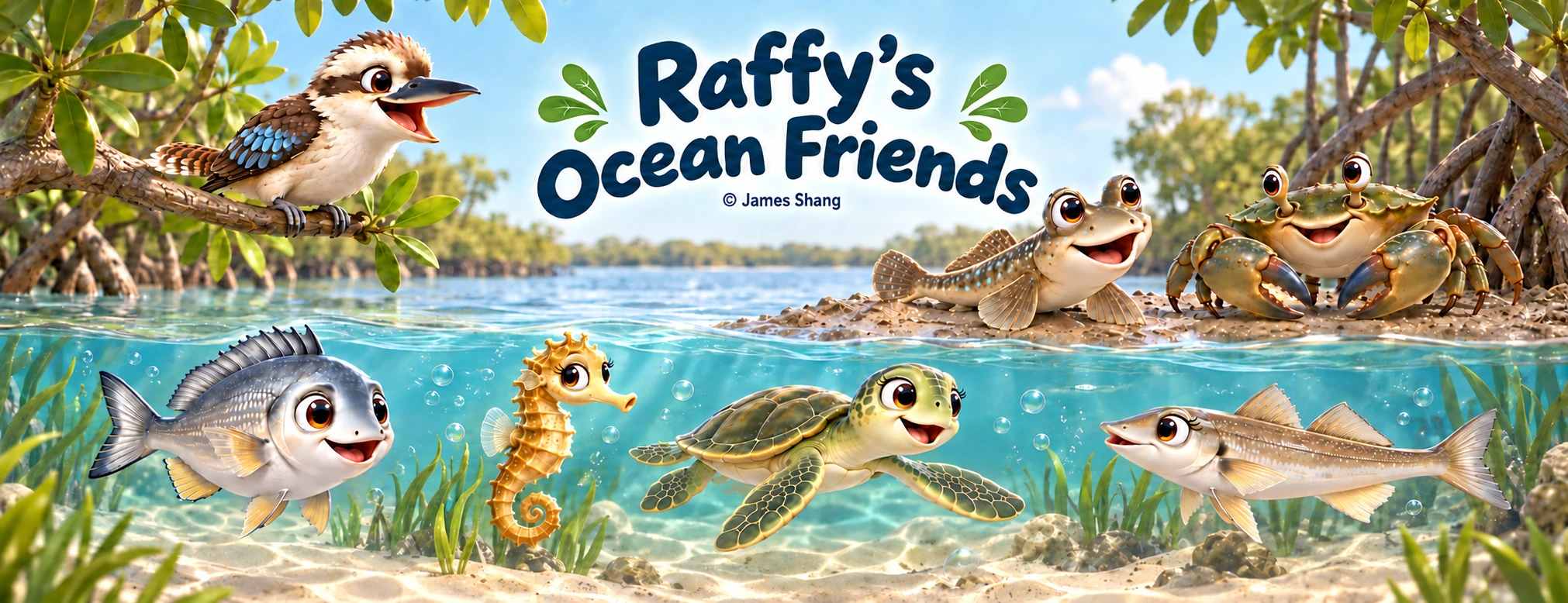
Raffy’s Ocean Friends is a story world created by James Shang, inspired by Australia’s coast and the small discoveries waiting at the water’s edge.
Through fun stories, music and play, Raffy’s Ocean Friends helps children discover the wonders of nature, care for our ocean and planet, and treat one another with kindness and respect.
A muddy bank can be the start of a grand adventure. A quiet friend can have the idea everyone needs. A little invitation can change someone’s whole day.
Our ocean. Our planet. Our friends.
Let’s look after them together.
That little question sits at the heart of Raffy’s world. Sometimes he asks to join in. Sometimes he is the one making space for a new friend.
Our stories bring humour, feelings and coastal discoveries together. Colouring, activities and Oceanese give families more ways to join in. Ocean care grows from affection for the characters and the places they call home.
Reading together gives you time to connect. Sharing stories can support language, spark imagination and help children explore feelings. You do not need to read perfectly. Enjoy the pictures, pause for questions and follow your child’s interests.
Try asking: “What do you notice?” or “What do you think happens next?” A few happy minutes count. Share the story in the language that feels comfortable for your family.
CURIOSITY STARTS HERE
A little mud, a big adventure. Ideas for playing together, and the childhood memories behind Raffy.
From a childhood watching mudskippers in Townsville to a little world of stories and friends.
Read the article →